

Web Enrollment

IDEMIA
User Interviews, User Flow, Sketching, Wire-framing, Prototyping, User Testing, UI Design, Dev-Design Pairing, Presenting

IDEMIA's Web Enrollment promotional page
Who:
Primary user: Customer Service Representatives (CSRs) sit behind the counters at Department/Registry of Motor Vehicles (DMV/RMV) locations across the U.S. They are the primary user of IDEMIA's product, Web Enrollment. They serve everyday people applying for or renewing their ID.
Secondary user: Individuals applying for or renewing their ID at the RMV/DMV.
What: CSRs are responsible for collecting the data required to approve an applicant for a new ID. This includes capturing their photo, signature, collecting documents, and for some states, capturing their fingerprints.
Our Web Enrollment app did not offer fingerprint capture integration. As part of an effort to satisfy Request For Proposals (RFPs) from new states and to place competitive bids, our sales reps needed our team to build this crucial functionality.
While IDEMIA had the fingerprint capture devices, we didn't have an interface to support it in our web app.
We built a comprehensive fingerprint capture workflow within Web Enrollment that seamlessly integrated with our fingerprint capture devices. This addressed a wide range of state requirements, giving our sales team a competitive and configurable feature offering to submit as part of RFPs.

IDEMIA fingerprint capture device that was subsequently integrated with our web app
Requirements
As part of our Web Enrollment app, we needed to add configurable Fingerprint scan capabilities so CSRs could efficiently capture multiple types of fingerprints, while testing against Quality and Match Scores.
I was initially given a pretty vague set of requirements:
There had to be capabilities for capturing multiple fingerprints
A Quality and Match status needed to be displayed
A user needed the ability to recapture a fingerprint when it failed (ex: broken arm, loss of limb)
A user needed the ability to override when applicable
"The fingerprint capture is a key part of their process. We're validating that the people who show up to get their IDs, are who they say they are." - IDEMIA Sales rep
Understanding Fingerprints
What is a Fingerprint Quality Score?
Fingerprint scanners work by capturing the pattern of ridges and valleys on a finger, fingers, or one’s entire hand. The quality of the print is then determined by how much minutiae (or very specific features of the print) are able to be captured and converted into a unique code. The better the minutiae captured, the better the Quality Score (i.e., meeting state standards), and the more likely it will result in an accurate match.
What is a Fingerprint Match Score?
When someone’s fingerprint is first taken, it is enrolled in a system and assigned a unique code. On each subsequent capture, the system will validate that unique code against the newest capture. The closer the match, the better the Match Score. The higher the Match Score, the higher the likelihood that someone is who they say they are.

Final Version: example of 3 fingerprint capture
Impact
By creating a configurable design that captured a wide range of fingerprint combinations, we were able to build a solution that scales, an impact that's still felt today.
This feature has since been developed into our app and implemented with our fingerprint capture devices statewide (i.e., all DMV/RMV locations across an enrolled state), in multiple states.
In addition to being highlighted on IDEMIA's website, this has served as a pillar in our sales team's marketability of the app.
This helped bolster the competitiveness of our RFP bids, empowering us to secure long-term statewide contracts. This amounted to millions of dollars in revenue for the company.
Research
One of the big limitations we faced was the inability to speak directly to states that we were competing for. As a result I had to go through our sales rep to collect second hand information and to answer questions I had regarding various RFPs.
Once I had an idea of what we needed to deliver, I began sketching and thinking of potential flows. I iterated and tested against these flows with both my team, internal staff, and our sales reps, eventually crafting a series of solutions that allowed us to put out a competitive feature offering.
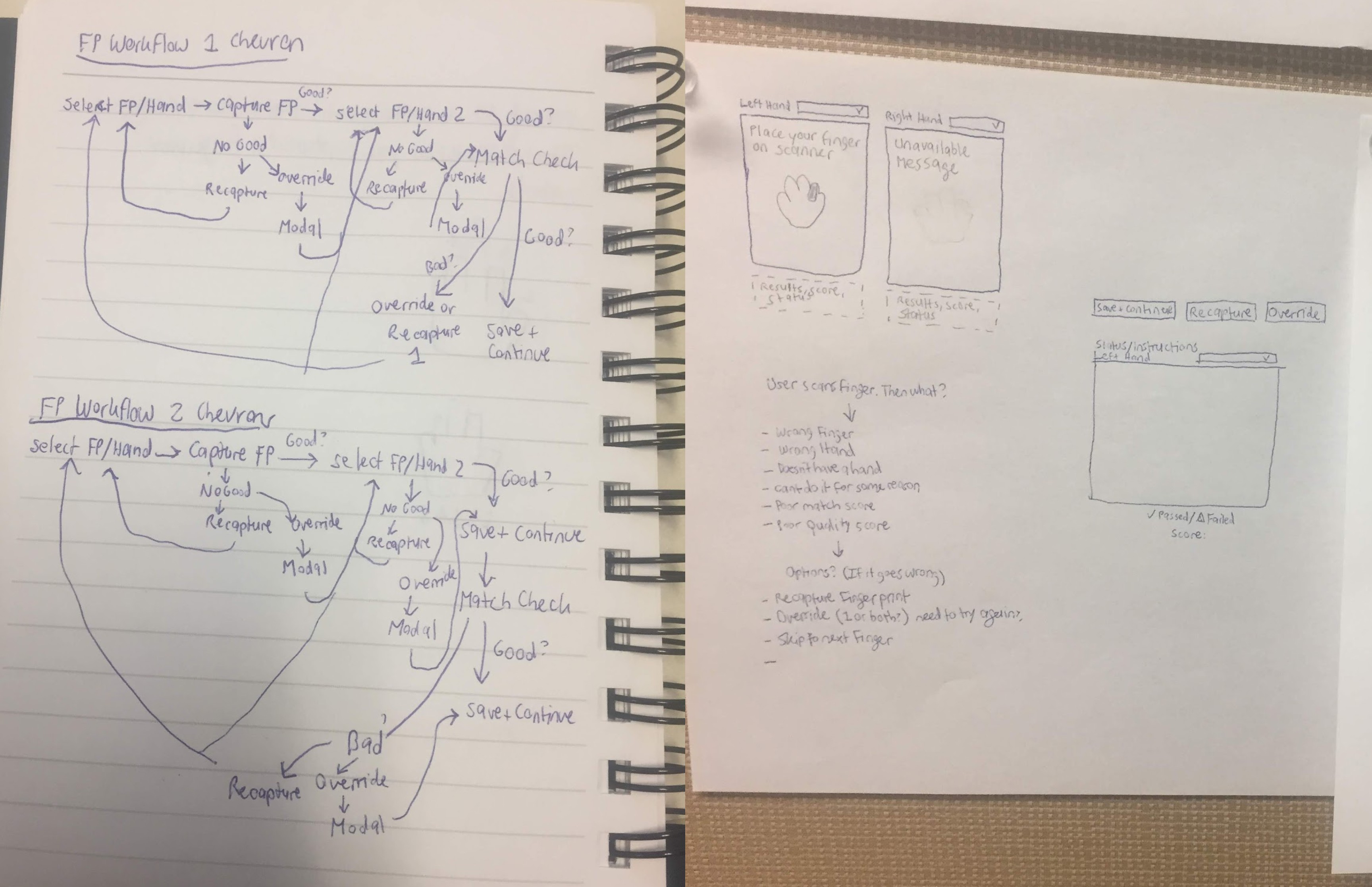
Early logic and thinking through the flow

Montage of some early sketches and mockups

Simulating the fingerprint capture flow
Here's How We Built Web Enrollment's Fingerprint Capture Feature
1
We created a versatile, interchangeable set of workflows utilizing different panels
2
This enabled different states to set and lock/unlock their own fingerprint combination requirements
3
We broadened our UX to include keyboard shortcuts for those unable to use a mouse
1
Flexible Workflows
1 and 2 Screen Flows

To appease the varied needs of states, we crafted a one screen and two screen fingerprint capture flow. At the center of this flow are panels.
Panels

Panels would shape shift and could hold fingerprint capture, quality status, or match status. There could be several panels in a flow. This gave us a good skeleton as we pieced together designs. Over time, these would be fleshed out to guide CSRs through the fingerprint capture flow
1 Screen Flow: Quality and Match

Fingerprint capture: Quality and Match on 1 screen
2 Screen Flow: Quality then Match

Fingerprint capture: Quality and Match across 2 different screens
Results
We were able to offer states different user workflows based on their requirements and/or preferences
Pass/fail fingerprint captures accurately based on their Match and Quality validation scores.
Efficiently capture and validate fingerprints within seconds
2
Configurable Fingerprint Combos
Locked Combo

Some states required certain combinations of fingerprints, with no flexibility
Unlocked Combos

Other states gave CSRs the power to change fingers if an applicant's fingerprint couldn't be captured
Overriding Locked Combos

If a user had a broken finger and was unable to take a fingerprint, an Override could be initiated
Results
Made it seamless for the CSR to capture fingerprints from a wide pool of applicants on a given day
Gave the CSRs increased flexibility. For example, if the state locked requirements, the CSR could override if needed. If the state unlocked requirements, the CSR could switch fingerprint combinations to better suit the applicant.
It made Web Enrollment more attractive to prospective states
3
Accessibility
Keyboard Accessibility

We mapped each action, making all functions available on a keyboard for disabled users; Some users even preferred the keyboard shortcuts, saying it was faster to get through the flow

This simulation walks through how a CSR could change an unlocked fingerprint combination (Left Hand panel) from their keyboard. First they'd press the number they wanted to change and then they'd select the number they wanted to change to. This allowed them to efficiently create new combos based on applicant edge cases
Results
Our keyboard shortcuts made capturing fingerprints, from start to finish, accessible to disabled CSRs so that they could comfortably do their job.
Note: Some CSRs can only use a keyboard and not a mouse due to various physical disabilities that affect their hand movement, such as those with limited dexterity, repetitive strain injuries, etc. This can make precise mouse control difficult or impossible.
Provided additional options for CSRs to move through the workflow.
Impact
By creating a configurable design that captured a wide range of fingerprint combinations, we were able to build a solution that scales, an impact that's still felt today.
This feature has since been developed into our app and implemented with our fingerprint capture devices statewide (i.e., all DMV/RMV locations across an enrolled state), in multiple states.
In addition to being highlighted on IDEMIA's website, this has served as a pillar in our sales team's marketability of the app.
This helped bolster the competitiveness of our RFP bids, empowering us to secure long-term statewide contracts. This amounted to millions of dollars in revenue for the company.